Poland’s Crypto License Deadlock: Where VASP-Registered Companies Are Relocating Under MiCA

Poland has no authority able to issue or supervise CASP/MiCA licenses. The implementing Act has been vetoed by the President three times, most recently on 11 June 2026.
The EU-wide MiCA transitional period for nationally registered providers ended 1 July 2026 – a deadline KNF itself has confirmed it cannot extend.
Estimates of how many Polish VASP-register entries this affects range from roughly 1,400 to 2,000+, depending on the source and count date.
Companies are relocating along two different tracks: fast non-EU registration (Saint Lucia, Canada, Switzerland) with no EU passport, or slower EU CASP licensing elsewhere (e.g. Austria) that keeps one.
The real choice is speed versus market continuity – not a simple ranking of “best” jurisdictions.
What happened
Poland’s Act on the Crypto-Asset Market – the law meant to name a domestic authority for supervising crypto-asset service providers under MiCA – has now been vetoed three times by President Karol Nawrocki, most recently on 11 June 2026. Each veto has centered on the same objection: that the draft gives the regulator powers seen as excessive, including the ability to block websites and freeze client funds for extended periods before an appeal concludes.
The practical result: as the Polish Financial Supervision Authority (KNF) confirmed in its own 10 February 2026 statement, “no national public administration body has been designated in the territory of the Republic of Poland as the competent authority” for crypto-asset service providers – with the narrow exception of e-money token issuers, where KNF does have a mandate. KNF was equally direct about the calendar: the aforementioned deadline “cannot be extended… by a decision of the KNF,” because it is set by EU regulation, not domestic law.
That deadline – the end of the Article 143(3) transitional period for providers registered under national regimes – fell EU-wide on 1 July 2026. Poland’s own VASP register, run by the Tax Administration Chamber in Katowice, had already stopped accepting new entries on 30 December 2024. From 1 July, existing entries no longer authorize their holders to operate domestically as a VASP or CASP. ESMA had already spelled out the consequence back in April: any entity serving EU clients without MiCA authorisation after that date is in breach of EU law, and is expected to run a wind-down that is “operational, credible, and immediately executable” – client notice, asset transfers to an authorised CASP or self-custody, and AML/CFT compliance maintained throughout.
How many companies does this actually touch? Depends who you ask. CoinDesk reporting on 29 June 2026 put the pre-MiCA Polish VASP count at “over 1,400”; a separate CoinDesk piece on 1 July cited Morphic Financial Group’s CEO, Mateusz Kara, giving a figure closer to 2,000 – and adding, “as far as I know, we are the only ones that have a MiCA license right now.” That claim is worth reading as what it is: one operator’s own account of the field, not an independently confirmed count. Either way, the order of magnitude is the same – most of Poland’s registered crypto businesses now have no legal basis to operate, and almost none of them have replaced it yet. The same reporting, citing BitGo CEO Mike Belshe, put the EU-wide picture at rroughly 244 MiCA-authorised CASPs against several thousand firms that had operated under national pre-MiCA regimes. OKX Europe CEO Erald Ghoos has separately estimated, in comments carried by CoinDesk and The Block, that up to 80% of Europe’s crypto firms may not survive the transition.
Where companies are actually going
None of this leaves a Polish VASP holder with a domestic option. The realistic paths run through other jurisdictions, and they split into two groups that don’t compare on the same axis.
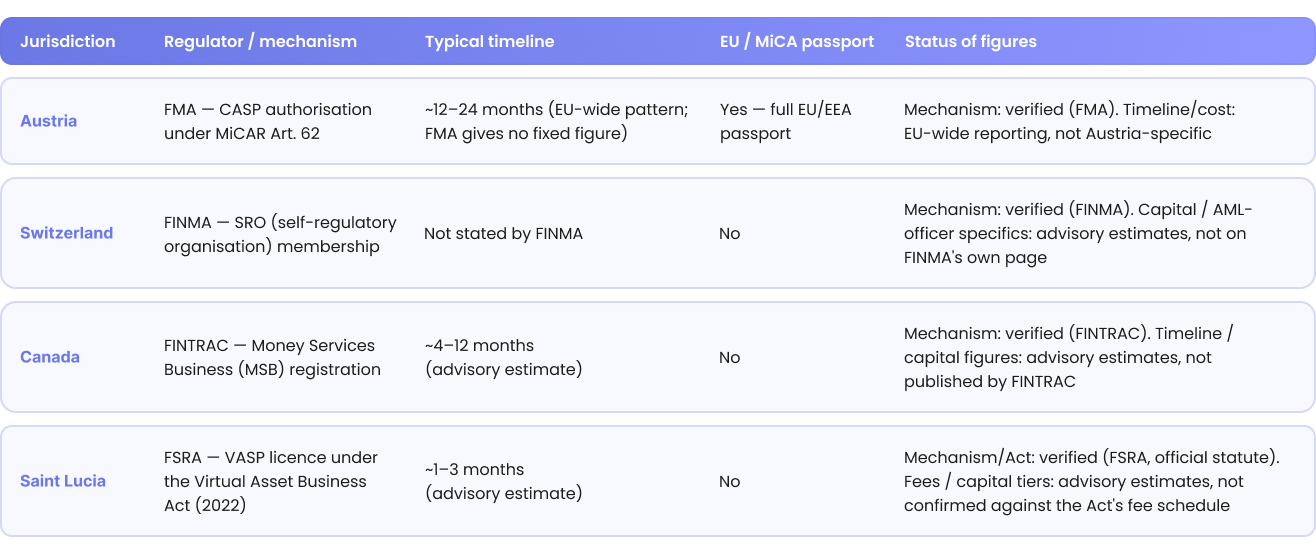
Austria is the one EU route in this comparison. As an EU member state applying MiCA directly, a CASP license issued by Austria’s Financial Market Authority (FMA) carries full EU passporting rights once granted – the EU market access that a Polish MiCA authorisation would have provided.
The FMA is explicit that it won’t commit to a fixed timeline: authorisation duration “depends on the quality of the application, the documents submitted, the complexity of the corporate structure… and the underlying business model,” and it encourages applicants into pre-authorisation meetings before filing.
In practice, that tracks the EU-wide pattern reported by CoinDesk: roughly 12–24 months to a first authorised trade, with locked capital requirements in the €50,000–150,000 range by license class and first-year compliance costs commonly cited in the low hundreds of thousands of euros. It means going through the MiCA authorisation process in a jurisdiction where a competent authority is already operational – unlike Poland, where no domestic CASP authorisation route was available by the end of the transitional period.
Switzerland, Canada, and Saint Lucia sit in the other group: none of them apply MiCA, so none grant an EU passport. What they offer instead is speed, at the cost of leaving the EU client base outside the new registration. See the comparison table below.
What this means for a Polish VASP holder
The obvious framing – “which of these four is the best jurisdiction” – misses what’s actually happening. Speed and EU market continuity move in opposite directions here. A company that chooses Saint Lucia or Canada may obtain a local registration or regulatory status faster, but this does not replace MiCA authorisation or provide EU passporting rights.
A company that picks Austria keeps that market, but is really just re-running the same MiCA-length authorisation process that stalled in Poland – this time somewhere it can actually finish.
Neither choice is wrong. But they’re answers to different questions, and a decision made under deadline pressure on “which is fastest” tends to assume it’s answering the market-access question too. It usually isn’t.
Where OpiniQ sees this
We’ve had a rising number of these conversations since the veto on 11 June. Most start as a jurisdiction comparison and end as a harder question: whether the business can still serve the EU clients it already has, wherever it re-registers. OpiniQ works with Polish VASP-registration holders on that question – helping map, in coordination with licensed advisors, what each relocation route practically involves before a company commits to it.
At OpiniQ, we support organisations with documentation, coordination, and project management. Where specialised or regulated services are required, these are provided by licensed professionals within our partnership network.